Another week, another round of UN sanctions against North Korea
With it comes another demonstration of how adept Beijing is becoming at inching back and forth along the policy tightrope it has installed between Washington and Pyongyang.
At the same time, muttering mounts among Chinese experts and the public as to the wisdom of tightrope walking and the availability of alternatives.
To placate the United States and signal displeasure with North Korea, China voted for the latest sanctions even as it insisted on watering them down to let Kim Jong-un know that China will not let him fall.
Beijing does not believe that sanctions will force the North Korean leader to surrender his weapons.
It wants Washington to talk to Pyongyang. And it wants Pyongyang to stop nuclear and missile tests.
But neither is listening and with the North Korean tests accelerating and rhetoric on both sides escalating, the stakes are very high. The last war on the Korean peninsula pitted the US against China at a cost of millions of military and civilian
Unilateral pre-emptive military action by the US would risk conflict with China again. Despite deep frustration with Kim Jong-un, North Korea is a Chinese neighbour and ally, a fellow Leninist state with a shared victim narrative about the past and a shared ambition for the future to remove the US presence in North East Asia.
Moreover, the chief objectives of the Chinese Communist Party are domestic: stability at home and its own firm grip on power. Its current assessment is that these objectives are best advanced by keeping Kim Jong-un in place.
So while China does not want a nuclear North Korea, it wants a North Korean collapse even less and it will resist any sanctions which risk that outcome. Especially as it does not believe measures like a full oil embargo would push North Korea to disarm but instead force it further into a corner.
Co-operation and mistrust
It's hardly surprising that Beijing empathises with North Korean insecurity, given that for decades it suspected the US of plans for containment and regime change to remove the Chinese Communist Party. It wants the US to talk to the Kim regime as a first move in building trust.
So co-operating with the latest round of strengthened sanctions is China's way of signalling its displeasure with what it sees as Pyongyang's reckless pursuit of nuclear and missile programmes. And a way to avoid accusations of complicity from Washington and any danger of its economy suffering significant damage from secondary sanctions against Chinese companies.
 AFP
AFP
peninsula.
And while it carefully inches back and forth along its tightrope, the geopolitical landscape beneath is shifting. For example, North Korea's accelerated drive for nuclear weapons raises the question of whether and for how long South Korea and even Japan will remain non-nuclear
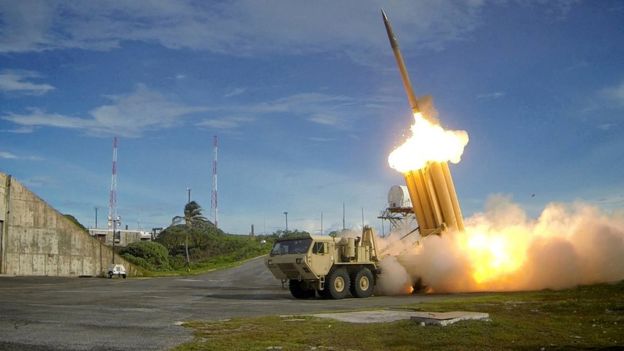
Already China has risked its previously burgeoning relationship with Seoul to punish it for deploying an American anti-missile system known as Thaad (Terminal High-Altitude Area Defence). Even now Beijing fails to exploit the cracks that have emerged between President Donald Trump and South Korea's President Moon Jae-in because of its loathing for Thaad.
But that missile defence system was deployed as a response to North Korea's weapons programme. A new arms race now threatens to undermine China's grand plans to ease the US out of North East Asia and dominate regional security. Nuclear weapons in South Korea or even Japanese hands may be next.
With India, Russia and Pakistan already nuclear powers, not to mention the US, China may end up with more nuclear armed neighbours than any other country in the world.
Chinese patience overstretched
Strict censorship keeps public debate at bay, but there are signs of growing unease among experts and public alike, a growing number of voices pointing out that North Korea is getting away with undermining Chinese national interest.
But it is hard for China to climb down from its practised tightrope act to tackle the underlying strategic landscape. Any lasting solution to the Korean problem will require greater trust between China and the US and sustained negotiations between all interested parties on long term security for the peninsula.
They will have to discuss what a peace treaty would look like to conclude the Korean war, diplomatic recognition of Pyongyang, security guarantees, economic engagement and perhaps even in the long run the departure of US forces.
The risks to China of such an endeavour would be very great, particularly as the partners are so singularly unpromising.
Comments
Post a Comment